In the South East logistics market, procurement teams are moving towards assets that integrate with digital infrastructure. As e-commerce fulfilment centres in Kent and across the UK face rising labour costs and tighter delivery windows, the hardware you choose today must support the automation you implement later.
Investing in forklift sales is a strategic decision that dictates your facility’s throughput capacity for the next decade.
Why Is Reactive Buying Creating Technical Debt in Your Warehouse?
Warehouse managers previously bought forklifts based on immediate needs. If a mast failed or a lease ended, you ordered a similar model. The future of material handling is moving towards predictive infrastructure where every vehicle acts as a data node within your Warehouse Management System (WMS).
When you evaluate forklift sales for automated warehouse systems, you require specific lifting capacities and machines that will eventually navigate without a driver. The gap between traditional manual trucks and automation-ready units will start to widen. Businesses that fail to address this gap face a total fleet overhaul later. This process is expensive and disruptive.
What Are the Essential Technical Standards for Automation-Ready Forklifts?
UK facilities are moving toward a hybrid model. This involves human-operated trucks working alongside Automated Guided Vehicles (AGVs) and Autonomous Mobile Robots (AMRs). To operate in this environment, your manual fleet must possess specific technical traits. Local forklift sales increasingly focus on these high-specification models to ensure long-term compatibility.
CANbus Integration and Telemetry: Most providers now prioritize machines equipped with IoT sensors. These sensors integrate into the vehicle’s CANbus (Controller Area Network) to track location and hydraulic oil temperature. They also monitor motor brush wear and battery discharge curves. In an automated environment, this connectivity allows the WMS to divert an automated pallet mover if a manual truck signals a fault. For your business, this prevents mechanical failure from turning into a total gridlock in the aisles.
True Drive-by-Wire Hardware: Older forklifts rely on mechanical or hydraulic linkages for steering and braking. To automate a truck, it needs electronic interfaces. Choosing machines with true drive-by-wire capabilities ensures that you can install automation kits in the future. Because these units lack a physical steering column, a software controller can manage the steering rack directly. Brands like Cat Lift Trucks utilize these electronic interfaces to facilitate smoother transitions to semi-autonomous operation and autonomous haulage integration. This capability reduces the long-term cost of ownership because you do not have to replace the entire chassis when you decide to automate.
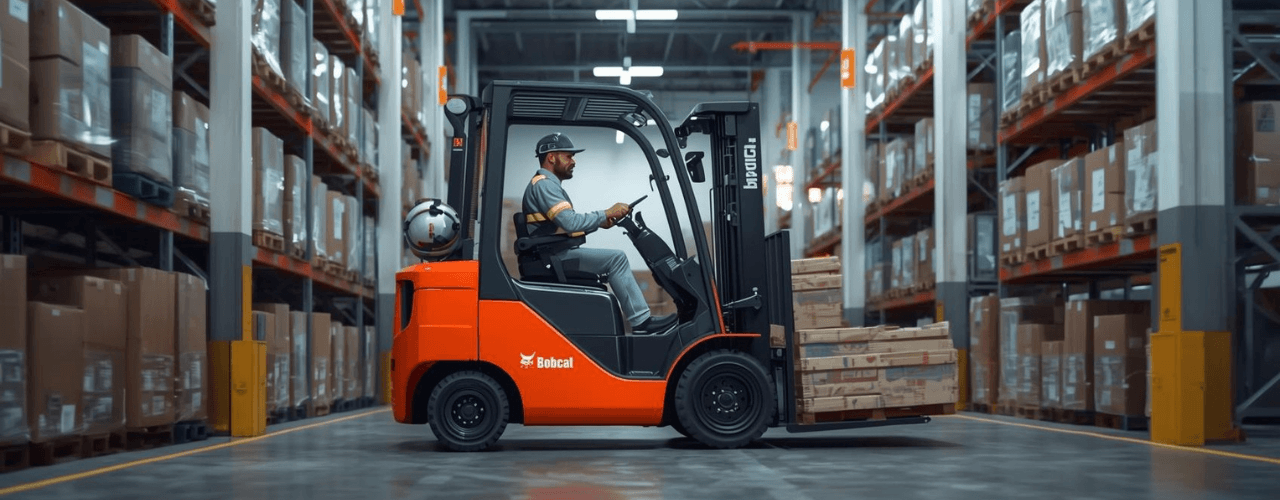
Precision Mast Stability: Automation requires high precision. When a robot picks a pallet from a high rack at 12 metres, there is no room for hydraulic drift. Brands like Bobcat and Manitou are refining mast stability and tilt speeds through systems like Smart Handling (SHS) and Joystick Switch & Move (JSM) to meet these standards. This precision helps manual operators reduce product damage while improving cycle times during high-speed picks. Faster, safer picks directly correlate to higher hourly throughput without increasing your headcount. Modern forklift sales transactions often depend on these validated precision metrics.
Will Automation Replace Your Forklift Operators or Upskill Them?
One significant change in commercial forklift sales for e-commerce fulfilment centres is the impact on human labour. Automation does not remove the need for people. It shifts their responsibilities.
As you integrate automated systems, your forklift operators transition into fleet supervisors. Instead of performing the repetitive task of moving a pallet 200 metres across a floor, they focus on complex manoeuvres. This shift addresses the labour shortages in the South East. You can move more volume with a smaller, more highly skilled team. This transition lowers your recruitment and training costs over time.
How much of your current labour budget is wasted on operators driving empty trucks across the warehouse? Need help with efficiency for warehouse machinery? Contact us!
Why Is Lithium-Ion the Standard for Automated 24/7 Operations?
The battery room is becoming obsolete. Traditional lead-acid batteries require dedicated charging areas and ventilation for gasses. The future of material handling is built on Lithium-ion (Li-ion) technology. Consequently, current forklift sales trends show a rapid decline in lead-acid demand in favour of zero-maintenance electric units.
In an automated warehouse, opportunity charging is the standard practice. A manual operator can plug the machine in for 15 minutes during a break to gain a power boost. This eliminates the need for battery swapping. Li-ion batteries provide a constant voltage and maintain full performance until the battery is empty. For an automated system, this consistency is necessary for maintaining programmed travel speeds throughout a triple-shift operation. This eliminates the “sluggish” performance at the end of a shift that often causes human error and missed delivery targets.
Is Your Warehouse Floor Flat Enough for Autonomous Vehicles?
Site managers frequently overlook the warehouse floor when moving toward automation. While a human driver can compensate for a dip in the concrete, a laser-guided AGV cannot.
When considering the best forklifts for automation-ready warehouses, you must audit your floor flatness against TR34 standards. While standard retail floors often meet FM3 specifications (suitable for lifts up to 8m), high-speed automation and reach trucks operating between 8m and 13m frequently require FM2 tolerances. Investing in a high-spec truck is wasted if the floor causes sensors to lose their heading. Vibration from uneven joints can also trigger an emergency stop. Our team can help evaluate your floor specifications alongside your equipment selection. Solving floor issues during the procurement stage prevents expensive downtime once the robots go live.
What Is the Benefit of Sourcing Forklift Sales Locally in Kent?
The Southeast is a primary hub for UK logistics. Kent warehouses face higher pressure than many other areas in the country due to their proximity to the Channel ports. This makes the local support from Glosrose a strategic asset.
While the technology in a modern forklift is advanced, the mechanical components still require manual maintenance. A software-enabled forklift that stops working due to a sensor fault is just as useless as one with a broken chain. Having a partner that offers same-day response in Kent ensures your high-tech investment stays operational. We provide a link between global technology and local reliability. This local presence minimizes the “hidden cost” of downtime that global vendors often ignore.
Should You Choose Contract Hire or Outright Ownership for New Tech?
The speed of technological change makes outright ownership a financial risk. If you buy a fleet today, you are locked into that technology for the life of the machine. Many UK warehouses are increasingly moving toward long-term forklift hire.
Contract hire allows you to hedge your bets. You get the latest technology today and can upgrade to the next generation of automated kit at the end of the term. This keeps your capital free for other business investments. It also simplifies your balance sheet by turning a variable maintenance cost into a predictable monthly expense. For a business, this predictability is vital for long-term cash flow management. Procurement teams often weigh these flexible options against traditional forklift sales to manage rapid technological cycles.
Do not wait for your competitors to automate their logistics before you act. Contact Glosrose today to discuss how our current forklift sales options can prepare your facility for the next decade of material handling.