Forklift noise becomes a problem when a site sits close to housing or operates in enclosed spaces such as warehouses. In those conditions, noise moves from a background issue to a planning and compliance risk that attracts scrutiny from clients and local authorities. For contractors and site managers running Bobcat fork lifts, the real question is no longer how loud the machine sounds, but whether the setup, use, and environment of those Bobcat fork lifts can be justified before complaints or inspections.
What Do UK Noise Regulations Require for Forklift Noise?
UK noise regulation takes a risk-based approach instead of applying a single universal limit to forklift use across sites. Workplace exposure thresholds exist under health and safety law, while planning and nuisance controls depend on site conditions. This includes Bobcat fork lift noise considerations for UK sites. The guidance places responsibility on employers to:
- Assess noise exposure risks.
- Reduce noise where reasonably practicable.
- Justify equipment choice and control measures.
- Review conditions if work patterns or environments change.
However, inspectors hardly ever focus on one measurement in isolation. Questions tend to arise when reviewers examine a method statement or request justification after a complaint.
From a business perspective, poor documentation and weak justification often cause more disruption than the machine itself. The disruption comes from having to explain decisions after the fact.
Why Is Forklift Noise a Bigger Issue on Some Sites Than Others?
Forklift noise becomes more sensitive when site conditions amplify it or when tolerance drops, a common issue when Bobcat fork lifts are used across varying environments.
Common examples include:
- Urban and mixed-use developments near housing.
- Sites with early starts or late finishes.
- Warehouses with enclosed spaces and hard reflective surfaces.
- Locations where multiple machines operate at once.
On sites close to residential zones, complaints can escalate once noise becomes noticeable beyond site boundaries. Once noise becomes a planning or neighbour issue, sites face reactive changes that disrupt programmes and increase costs.
What Affects Noise Levels on a Bobcat Fork Lift in Practice?
When reviewing noise control measures for Bobcat fork lifts, including specific Bobcat fork lift options available for different site conditions, focus on the fact that output rarely comes down to brand alone.
In a daily use, several practical factors have a greater impact:
- Engine configuration and power: oversized machines working at low load can create unnecessary noise.
- Attachments: poorly matched or worn attachments increase vibration and handling noise.
- Tyres: solid tyres, uneven wear, and poor surfaces all raise noise levels.
- Maintenance condition: worn components and loose fittings add mechanical noise.
- Operator behaviour: revving, harsh acceleration, and constant idling all contribute.
Focusing on a single specification does not resolve the issue.
Does Forklift Noise Reduction Start with Setup Rather Than Replacement?
This is usually the point where bringing in an experienced plant partner makes sense. Working with a supplier that understands site constraints, hire flexibility, and long-term maintenance allows teams to pressure-test setup decisions before they become difficult to defend.
This applies directly when reviewing Bobcat fork lift setup for noise compliance. The starting point is making sure the forklift is suited to the task and environment.
That includes:
- Matching machine size and power to the actual workload.
- Avoiding overpowered equipment for indoor or low-speed work.
- Selecting attachments designed for smooth handling.
- Keeping maintenance schedules tight and documented.
- Setting clear expectations for how the machine is operated on site.
From a business point of view, this approach reduces complaints and avoids enforced working-hour restrictions. It limits the risk of last-minute operational changes and makes it easier to defend decisions when site conditions are questioned.
If site conditions are changing or noise sensitivity is increasing, short-term or flexible hire options allow teams to adjust equipment choice without locking themselves into a setup that becomes difficult to justify later.
Using Bobcat Fork Lifts on Noise-Sensitive Sites
Warehouses
Here, Bobcat fork lift suitability for warehouses becomes particularly important.
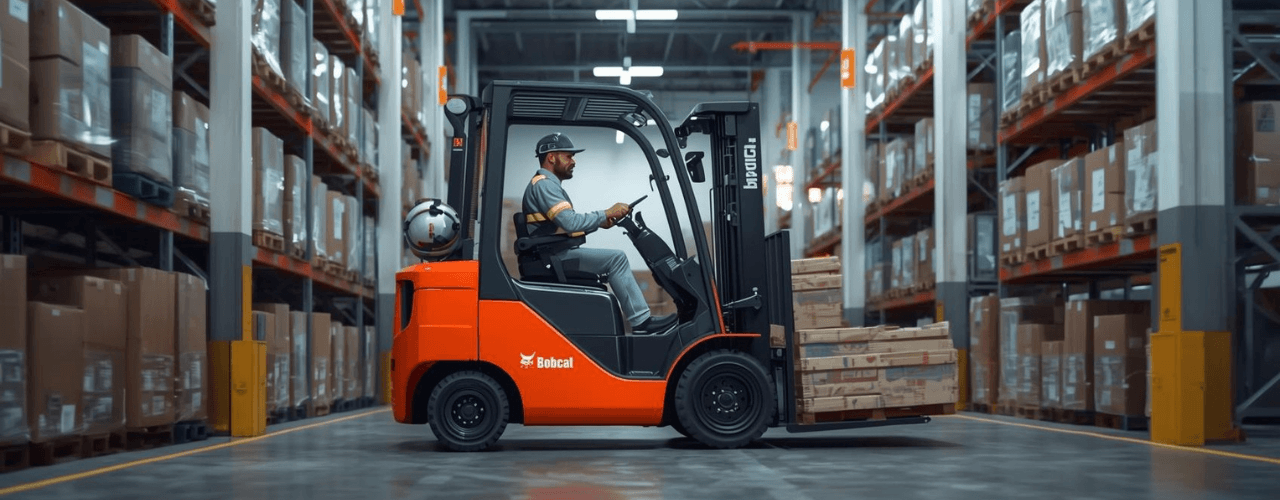
In warehouses, Bobcat fork lifts often operate continuously and in close proximity to people. Noise builds up quickly due to enclosed spaces and reflective surfaces. Over a shift, even small inefficiencies in setup or operation increase exposure.
On these sites, low-noise operation depends on smooth handling, appropriate tyres, and consistent maintenance.
Urban and Residential Sites
This scenario commonly arises when using Bobcat fork lifts near residential areas, where tolerance is lower and scrutiny increases.
On urban sites, tolerance drops and scrutiny increases further. Early starts, evening work, and weekend activity are common pressure points. At that stage, flexibility disappears and changes become reactive rather than planned.
On these sites, choosing and setting up a Bobcat fork lift with noise in mind helps avoid disruption later.
What Does Forklift Noise Compliance Look Like in Practice?
Compliance depends on being able to show that noise has been properly considered and managed, rather than on whether a forklift is described as “quiet.”
That typically means:
- A clear noise risk assessment.
- A reasoned explanation of why the forklift is suitable for the site.
- Practical control measures.
- Ongoing review if site conditions change.
When this information is in place, noise concerns are easier to resolve and far less likely to stall work. Clear justification removes uncertainty when scrutiny increases.
How Hire vs Ownership Can Affect Noise Control
Ownership often locks businesses into a single setup, even when site conditions change. Using short-term or flexible hire gives teams a practical way to respond to tighter noise controls without committing to unsuitable equipment. Hiring allows:
- Equipment to be matched to specific environments.
- Changes to be made if site constraints tighten.
- Noise considerations to be addressed without long-term commitment.
Teams often overlook this flexibility until a site comes under pressure, when options narrow and decisions become harder to reverse.
Sense-Checking Your Setup Before Noise Becomes a Problem
Noise issues rarely appear without warning on live sites where Bobcat fork lifts are in regular use. Complaints or inspections linked to planning reviews often trigger them. Addressing setup and suitability early helps avoid reactive fixes that disrupt work.
If you are using Bobcat fork lifts on noise-sensitive sites and want to sense-check your setup early, Glosrose can review suitability and options in a practical, site-led way. You can explore current Bobcat fork lift availability, hire options, and servicing support through Glosrose to ensure your setup remains defensible as site conditions change.