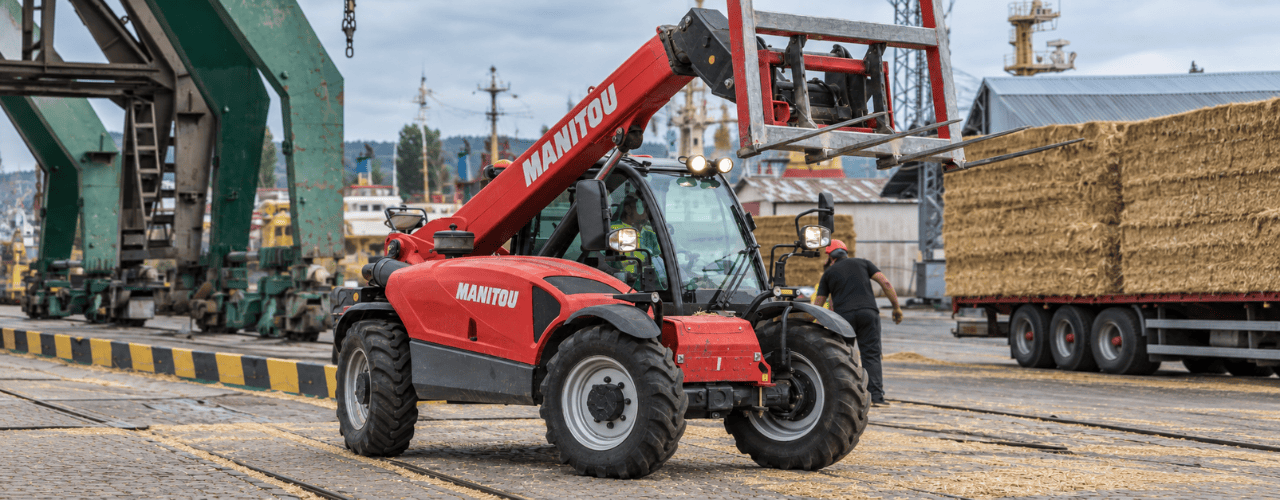
When Does Manitou Forklift Hire Suit a Mixed-Use Site?
Blog
If your operation moves materials between a warehouse, loading bay and yard, the question is...

UK warehouse eaves heights now exceed 13 metres across the M20 logistics corridor. This vertical shift makes standard reach truck specifications obsolete. A standard mast reaches its fatigue limit at 10 metres; attempting to push legacy equipment higher results in dangerous mast-deflection and reduced residual capacity. Kent businesses must match equipment to the building’s physical limits to prevent floor damage and maintain compliance with 2026 ABA standards.
A fork-tip at 13 metres acts as a massive lever. Even a tiny 1mm vibration at the chassis translates into a 150mm oscillation at the mast tip. This “mast-whip” forces operators to wait for the load to settle before they can safely place a pallet, which kills cycle times and leads to frequent rack-strikes.
High-rack environments require Active Mast Damping (AMD). This system utilises hydraulic compensators to counteract sway instantly.
AMD allows an operator to place a load the moment it reaches the beam, removing the 10-second “settling” delay required by uncompensated machines. When multiplied across a full shift, this saves hours of cumulative “dead time,” ensuring your warehouse throughput keeps pace with high-volume delivery schedules.
The Accrediting Bodies Association (ABA) updated workplace transport groupings on 19 January 2026, specifically refining the D1 and D2 categories. It is no longer enough for an operator to hold a general licence; fleet managers must now record the specific lift height used during the operator’s test.
If an operator tests at 8 metres but works at 12.5 metres, your site’s insurance policy is likely void in the event of an incident. Ensuring your team has the correct height-specific certification protects your business from the catastrophic legal and financial fallout of an “unqualified” accident.
Deciding whether to buy a new high-spec fleet or opt for a flexible hire contract depends entirely on your project’s longevity and cash flow requirements. If you are unsure which direction fits your current warehouse expansion, a consultation with a Glosrose specialist can help you weigh up the options available to fit the business needs
The load rating on the side of the chassis is irrelevant once you reach full extension. To find the safe working limit, you must consult the Residual Capacity Chart located on the console. For every metre you climb above the 8-metre mark, your weight capacity drops sharply. A machine rated for 2,000kg at ground level often hits a physical safety limit of just 600kg at 12 metres.
Ignoring these hard physics limits leads to mast-twist and permanent damage to shims and rollers. By specifying a Heavy-Duty (HD) chassis with wider base-legs, you protect your equipment’s lifespan and prevent the high cost of premature mast replacement.
Not every Kent warehouse needs to reach 13 metres. For operations where the priority is “Pallets per Hour” at standard 8-metre to 10-metre heights, the CAT Reach Truck range remains the logical choice. While high-bay specialists focus on structural rigidity at extreme heights, the CAT series is engineered for rapid acceleration and responsive hydraulic control.
The CAT’s precise steering and responsive lifting speeds save approximately 45 minutes of operator time per 500-pallet shift compared to generic fleet units. This translates directly into higher daily profit by increasing the number of vehicles your team can turn around in a single day. You are paying for speed and ergonomics that keep your best drivers productive for the full eight hours.
Staring at a 13-metre beam for an eight-hour shift causes severe neck strain. This fatigue leads to “end-of-shift” collisions where operators misjudge the fork-entry by just a few centimetres.
To combat this, we specify:
Reducing physical strain keeps your operators productive for the full duration of their shift. Preventing a single rack-strike through better visibility saves thousands in racking repairs and prevents site-wide shutdowns for safety inspections.
Ambient-spec machines will fail in a cold storage environment. In Dartford or Paddock Wood facilities, standard 32-grade hydraulic oil thickens at -20°C, which starves the lift pump and reduces travel speed by 30%. When speccing reach trucks for these sub-zero hubs, the focus must shift to component sealing and thermal management.
Glosrose specifies cold-store oil and Lithium-Ion (Li-Ion) batteries to prevent these “cold-soak” failures. Unlike lead-acid batteries, Li-Ion maintains a consistent discharge curve in the cold. This ensures your lift speeds stay constant until the very end of the shift, preventing the late-afternoon productivity slump common in refrigerated hubs.
The move to 13-metre racking in the South East has turned standard equipment into a liability. Working at these heights without the correct chassis spec creates an insurance risk and the potential for permanent floor deflection, a detail that landlord surveyors will flag during 2026 lease handovers.
Our consultative approach focuses on providing the exact technical specifications and machine data you need before a unit arrives at your depot. This ensures your equipment acts as a profit centre rather than a line-item expense. By reviewing your requirements before you commit to a fleet change, we help you avoid the common pitfalls of extreme vertical storage.
Unsure if your current fleet matches your site’s physical limits? Consult with a Glosrose specialist to verify your technical requirements
Not sure what you are looking for or need some advice for your requirements? Get in touch with us today and a member of our experienced team will be more than happy to help answer your questions.