Is Your Warehouse Outgrowing Its Current Forklift Fleet?
Blog
Is your warehouse forklift fleet keeping pace with growing demand? Learn how changes to loads,...
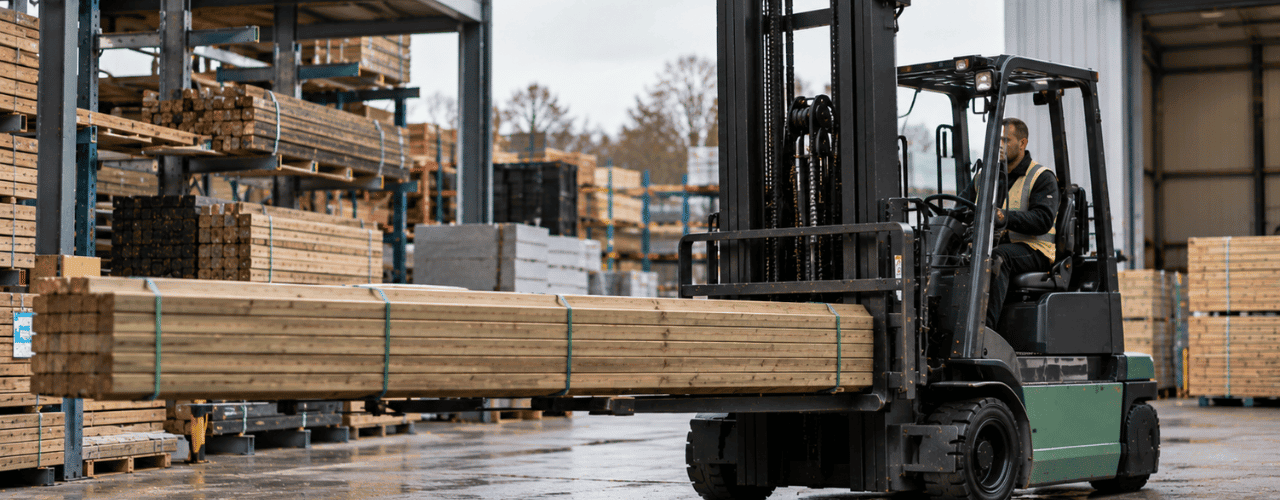
Long loads create a different handling problem from ordinary palletised goods. Timber packs, steel sections, pipes and profiles can extend well beyond the truck itself, increasing the space needed to travel, turn and approach storage positions. A forklift may have enough rated capacity for the weight and still be poorly suited to the route the load has to follow.
That is why long-load handling should start with the whole movement rather than the truck’s headline capacity. Load length, aisle space, turning room, travel direction and storage access can all affect whether a truck is suitable for a particular yard or warehouse.
If long loads are forcing wide turns or repeated repositioning, a Combilift forklift for long loads or another multidirectional truck may be worth assessing. Tell us the load dimensions, route and storage constraints and we can help narrow down suitable equipment.
Long loads change the space a truck and load need to turn, travel and approach storage, even when the forklift has enough capacity for the weight. With a conventional counterbalance forklift, the load itself becomes part of the turning and clearance requirement once timber, steel or another material extends well beyond the truck.
A route that is straightforward with a pallet can become restrictive when the truck has to turn into an aisle, pass a rack end, move through a doorway or approach a storage position with a much longer load. Repeated repositioning may then be needed simply to keep the material clear of walls, racking, stock or other fixed obstacles.
The most suitable long-load handling forklift therefore needs to do more than lift the weight. The truck and load must be able to travel through the actual route and place the material where it is needed with suitable clearance and access.
Forklift capacity is only one part of suitability. With a conventional counterbalance forklift, a long load can require much more room to turn and approach a storage position than a compact pallet of the same weight, and the final specification must also reflect how the load’s weight is distributed on the forks.
The length and shape of the material affect how much of the load projects beyond the truck, how much clearance is needed at corners and rack ends, and how the operator can line up with the pickup or storage point. If the actual load centre is further forward than the load centre used for the truck’s rated capacity, the available capacity can be lower. A truck that works comfortably in an open loading area may therefore be less suitable once the same load enters a narrow aisle or constrained yard route.
Useful checks include the tightest parts of the route, doorway and aisle widths, rack positions, turning areas and any places where the load has to change direction. Route planning and pedestrian controls should take the full dimensions of the load into account, not only the truck itself. These details give a clearer picture of suitability than headline capacity alone.
A multidirectional Combilift forklift can travel forwards, backwards and sideways, giving the operator more options for keeping a long load aligned with the route where turning the whole truck and load would require more space.
Sideways travel can be particularly useful where timber, steel or other long materials need to pass through a constrained aisle or between storage areas. Once the load is collected and aligned, a suitable truck may be able to travel with the material lengthways rather than needing enough room to turn the full truck and load.
This is the practical difference a multidirectional forklift for long loads can make. It does not remove the need to assess the route, load and operating environment, but it changes the movement options available where repeated turning or repositioning is a persistent part of the job.
A Combilift forklift for narrow aisles or constrained yard routes may suit long-load handling when restricted space makes conventional turning difficult. The deciding factor is whether multidirectional or sideloading movement solves a real route or storage constraint.
Applications can include timber packs, steel sections, tubes, profiles and other materials whose length makes crossways travel difficult in the available space. In these situations, multidirectional movement may allow the load to stay aligned with the route for more of the journey.
A conventional counterbalance forklift may still be suitable if it is correctly specified for the load and the route provides enough clearance to turn and position it.
A multidirectional forklift may be worth assessing where long loads need to pass through narrow aisles, doorways or other restricted routes without repeatedly turning the full truck and load.
Sideloading or multidirectional movement may reduce the amount of turning needed to reach storage positions where long materials are stored side-on, depending on the layout and application.
Where the same truck needs to handle both conventional pallets and long materials, the wider workload should influence the choice of equipment rather than selecting a specialist truck around one task alone.
Our multi-brand product sales approach means we can compare a Combilift forklift with other suitable handling options rather than starting with a particular truck. The right choice still depends on the load, route and work the truck must perform.
Timber yards and steel stockholders should check the longest regular load, the route it follows and the storage positions it must reach before choosing a forklift. Those factors help show whether the main restriction is turning room, aisle width, storage access or the way the load changes direction between unloading and storage.
For timber yards, pack length, rack spacing, yard routes, loading areas and movement between storage and dispatch can all influence which truck type is practical. These are also the details to consider when assessing a Combilift forklift for timber handling, particularly if the same truck must also handle conventional palletised goods.
Steel stockholders and fabricators face similar route questions with beams, sections, tubes and other extended materials. If steel is your main application, our article on handling long steel loads with Combilift forklifts looks at that use case in more detail rather than repeating the same ground here.
You do not need to identify the exact truck or Combilift forklift model before speaking to us. Start by telling us what you are handling, where the load needs to move and what is causing difficulty on site.
We can then work through the details that affect equipment choice, such as load dimensions, lift height, aisle and doorway restrictions, storage access, ground conditions and whether the same truck also needs to handle conventional palletised loads. Site photographs or a simple layout can also help us understand where the main restrictions occur.
Because we take a multi-brand approach, we can discuss whether a Combilift forklift, another multidirectional or sideloading option, or a more conventional truck is the better fit for the application.
Start with the load and the way it needs to move through your site rather than choosing on capacity alone. If long materials are difficult to handle because turning space, aisle width or storage access is restricted, we can help you compare suitable long-load handling options and identify whether a multidirectional solution is appropriate. Speak to our team about your requirements.
Not sure what you are looking for or need some advice for your requirements? Get in touch with us today and a member of our experienced team will be more than happy to help answer your questions.